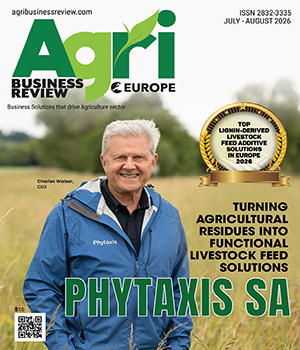
 Charles Walser, CEO
 Louis Pasteur once observed that ‘chance favours only the prepared mind.’
Phytaxis SA is a case in point.
Scientific progress rarely moves in a straight line and in the mid-2000s, the Swiss company was not even thinking about animal nutrition. Its team was focused on lignin, one of the most abundant organic polymers in plants, as a renewable alternative to petroleum-based chemistry. Oil prices were climbing, manufacturers were seeking substitutes for phenol in industrial resins and lignin extracted from wheat straw, bagasse and other agricultural residues offered a credible path forward.
Working on that challenge gave Phytaxis a great, practical understanding of lignin chemistry. The team learned how the molecule behaved, how it could be refined and how its structure could be shaped for functional use. That expertise later proved decisive.
When Europe banned antibiotic growth promoters (AGP) in 2006, feed producers faced a structural shift. They still needed to protect gut health, maintain feed conversion and keep production predictable, but they could no longer rely on the routine antibiotic tools they had used for decades. Around the same time, research from Japan and Cuba suggested that lignin could influence gut function.
For most companies, that connection would have passed unnoticed. For Phytaxis, it aligned with the team’s existing knowledge.
“We thought, let us try that in livestock, in feed,” says Charles Walser, CEO. “Back in 2008, we started to enter the market with trials and studies to find the real performance characteristics of this novel ingredient.”
You do not replace antibiotics. You make them unnecessary.
That decision reshaped the company. What began as a materials-science project evolved into a feed-performance platform built on a single idea that one plant-based ingredient could support multiple biological functions in the gut.
A Different Proposition for Feed Producers
Modern feed formulations operate under pressure from cost, regulation, sustainability expectations and performance demands. Every additive must justify its place, but most do so by solving one narrow problem.
Phytaxis took a different route.
Its modified sulphur-free soda lignin (MSFSL) ingredients are designed to strengthen the gut environment, supporting feed conversion, nutrient uptake and reduced reliance on antibiotics. It does not frame lignin as a direct antibiotic replacement. Its argument is ‘if the gut is more resilient, animals need fewer corrective inputs.’
“You do not replace antibiotics. You make them unnecessary,” says Walser.
The ingredient’s value lies in functional consolidation. It supports nutrient absorption by enhancing the intestinal surface area. It stabilises the gut environment and strengthens the barrier. It encourages a microbial balance that favours beneficial bacteria. It does so through a single, insoluble functional fibre that moves through the digestive tract and exits the system without binding vitamins or interfering with other feed tools.
For producers, this simplifies formulation. The ingredient works in premixes, withstands pelleting and fits multiple species and feed types. It gives feed companies a clearer point of differentiation in a market focused on natural, non-medicinal performance solutions.
Where Biology Becomes Economics
In high-volume sectors such as poultry and aquaculture, small shifts in feed conversion multiply across thousands of animals. A stronger gut can translate into better absorption, more efficient growth, lower treatment pressure and more predictable production cycles.
Walser argues that the industry still carries outdated assumptions.
“The industry is still built around outdated assumptions that productivity depends on antibiotics and that sustainability comes at the expense of performance. Both are wrong,” says Walser. “The next generation of animal nutrition must deliver more with less input, less waste and less environmental impact, without compromising results. That is the gap we are addressing.”
Evidence That Holds Up
The natural-additive market is crowded with broad claims. Phytaxis leans on trial data to separate itself.
A recent study at King Saud University tested Fibrafid, a Phytaxis product, in Ross 308 broilers over 35 days. The study tested Fibrafid at 0.15 per cent and 0.25 per cent inclusion rates in diets with standard nutrient density and in diets with 5 per cent lower amino acid density and 1.5 per cent lower metabolizable energy.

Birds receiving Fibrafid at 0.25 percent inclusion achieved the highest body weight in the trial, about 2,614 grams at day 35 and recorded the best feed conversion ratio at 1.25. Fibrafid also helped birds on reduced-nutrient diets recover performance that would usually decline under those conditions.
The gut morphology findings explain the performance. Compared with the reduced-nutrient control, Fibrafid improved jejunal structure. Villus height, width and surface area increased and goblet cell density rose by more than half. Better villi support stronger nutrient absorption, as more goblet cells indicate a more resilient mucosal barrier.
For producers, those results show the ingredient earning its place through feed efficiency and gut function.
Practical experience points in the same direction. In Switzerland, one piglet producer has used the product for years after observing healthier animals, faster growth and no routine antibiotic need in that production context, according to Walser. The producer initially turned to the product to reduce odour emissions from the facility, an important issue given a nearby restaurant with an outdoor terrace. Walser says the reduction was significant, helping improve coexistence with neighbouring businesses. Over time, the producer also reported improvements in meat quality alongside the operational performance benefits.
“He would not keep buying it if he did not see all those effects,” adds Walser.
The ingredient can work alongside probiotics. Improving the gut environment first creates conditions in which probiotics can establish and perform more effectively. Walser describes this as a synergistic effect, not just a competitive one.
Built for B2B Trust
A feed ingredient is only as strong as its supply chain. Phytaxis built its model around reliability, consistency and auditability.
It produces its own MSFSL, the base of its formulations. Each batch is tested for dioxins, pesticides, heavy metals and related contaminants. Production runs under FAMI-QS certification and the company is audited yearly under GMP+.
The raw material comes from agricultural residues such as wheat straw and bagasse, which often carry little value and may be burned in some regions. Phytaxis extracts lignin from black liquor, refines it and modifies it for feed use.
The sulphur-free distinction is important. Earlier lignosulphonates created negative perceptions in feed applications and Phytaxis spent years demonstrating that its material behaved differently. GMP+ certification in 2013 marked a turning point in broader acceptance.
-
The industry is still built around outdated assumptions that productivity depends on antibiotics and that sustainability comes at the expense of performance. Both are wrong. The next generation of animal nutrition must deliver more with less input, less waste and less environmental impact, without compromising results. That is the gap we are addressing.
Phytaxis moved early from lab-scale extraction to industrial capacity capable of batch and continuous production. Livestock and aquaculture markets require volume. A feed ingredient cannot remain a niche concept if supply cannot scale.
A Platform That Keeps Expanding
Lignin behaves differently across species, so Phytaxis tailors its formulations by application. In calves, the focus is on early immune development before weaning. In swine, the emphasis is on early-life stages. In poultry, the priority is growth, feed efficiency and gut structure. In aquaculture, the benefits extend beyond the animal into water quality.
Fish producers measure more than growth and feed conversion. They monitor faeces quality, ammonia levels, mortality and water stability. Firmer faeces and lower ammonia can ease pressure on production environments, especially in intensive systems, making lignin relevant for aquaculture operators.
The platform continues to widen. Phytaxis is developing a dairy formulation with a major partner to help reduce milk loss linked to heat stress. It is entering the pet market, where value is shifting towards owner-visible digestive benefits. Long-term, it sees potential in human nutraceuticals. Beyond feed, the same molecule supports petrochemical-replacement work through a sister company in the Tanovis Group.
Phytaxis reaches these markets through focused B2B partnerships, giving it depth without the overhead of a large field sales organisation. During the COVID period, the company accelerated the expansion of its product registrations into Latin America, Türkiye and the Middle East, adding to its established registrations in North America, Europe and Japan. Expansion into additional countries is planned. Subsidiaries in Mexico, the Netherlands, Türkiye and India provide regional access and technical support.
Each team is built around the expertise the work demands, not the illusion of scale. In Mexico, for example, the aquaculture team includes specialists with backgrounds in marine biology.
“There is always a team behind everything. It is very rarely a single person,” says Walser. “We do not have a huge sales team, but we have specialists from the different areas.”
The Bet Behind Phytaxis
Phytaxis is betting that the pressures reshaping animal nutrition all converge on the same need for animals to perform reliably with fewer inputs. Feed companies need ingredients that earn their place without complicating formulations. Markets need sustainability claims backed by measurable performance.

The company’s answer is a sulphur-free lignin platform that consolidates functions, strengthens gut resilience and arrives with the quality credentials B2B buyers require.
Its origin is unusual. A chemical technology team found one of its strongest markets within the digestive tracts of farm animals. Its value proposition is clear.
Phytaxis helps producers build feed products that support performance, reduce reliance on routine antibiotics and create measurable value from an ingredient derived from agricultural residues. In an industry under pressure to produce more responsibly without sacrificing efficiency, that combination matters.
“We are not asking producers to choose between sustainability and performance. We are showing how better gut conditions can help make both possible,” adds Walser.
That work has earned Phytaxis SA recognition by Agri Business Review Europe as one of the Top Lignin-Derived Livestock Feed Additive Solutions 2026, a distinction that reflects its role in bringing lignin-derived feed innovation into practical livestock nutrition.
Advancing Livestock Nutrition through Functional Lignin Innovation
European livestock producers face a tightening set of constraints that extends beyond productivity targets. Pressure to reduce reliance on antibiotics, manage input costs and demonstrate environmental accountability is reshaping how feed strategies are evaluated. Conventional additive models, built around supplementation rather than systemic gut interaction, often struggle to reconcile performance gains with these evolving expectations. The shift underway is less about incremental improvement and more about rethinking how a single input can simultaneously influence multiple biological and operational outcomes.
Feed decisions increasingly hinge on whether an additive can deliver measurable improvements without forcing trade-offs. Growth performance remains central, yet it is no longer sufficient in isolation. Producers are examining how efficiently nutrients are converted, how consistently animals maintain health without intervention and how downstream effects such as waste output or water quality are influenced. This broader lens reflects a move toward inputs that operate within the animal’s digestive system to support balance rather than correction.
Another emerging expectation is compatibility with reduced-input feeding strategies. Rising volatility in feed ingredient pricing has made it necessary to extract more value from lower-energy or lower-protein formulations. Additives that can sustain or improve outcomes under these conditions are gaining attention, particularly when they enhance nutrient utilisation rather than simply compensate for deficiencies. This distinction separates short-term supplementation from longer-term efficiency gains.
Adaptability across species and production environments also plays a decisive role. Livestock systems are not uniform, and solutions that require extensive reconfiguration for each application create friction in adoption. Buyers increasingly favour approaches built on a consistent underlying mechanism that can be adjusted at the formulation level without losing effectiveness. This allows producers to apply a unified strategy across poultry, swine, aquaculture or early-stage cattle development while accounting for biological differences.
Quality assurance and traceability have become non-negotiable elements in supplier evaluation. The ability to control raw material sourcing, maintain consistent production standards and verify the absence of contaminants directly influences confidence at the farm level. Certification frameworks and rigorous batch testing are no longer peripheral considerations but integral to how feed inputs are assessed for long-term use.
Within this evolving landscape, lignin-derived feed additives have moved from a peripheral concept to a subject of serious evaluation. Their role as insoluble fibres that interact within the gut offers a different pathway compared to microbial or enzymatic additives. Rather than introducing external biological agents, they influence the internal environment in which digestion and microbial balance occur, creating conditions that support healthier and more efficient nutrient processing.
Phytaxis SA exemplifies how this approach can be translated into a scalable solution. It has developed a sulphur-free lignin platform produced through proprietary extraction processes, enabling consistent quality and biological activity. Its formulations, largely built on a single modified lignin base, are tailored for species-specific needs while maintaining a unified mode of action. The result is observable improvements across metrics that matter to producers, including feed conversion, growth outcomes and reduced reliance on antibiotics. In aquaculture settings, it improves water quality by reducing ammonia and solid waste, while in terrestrial livestock, it supports gut health and lowers mortality. Its vertically integrated production and adherence to recognised quality standards reinforce supply reliability, positioning it as a credible choice for producers seeking performance gains aligned with modern constraints.
...Read more