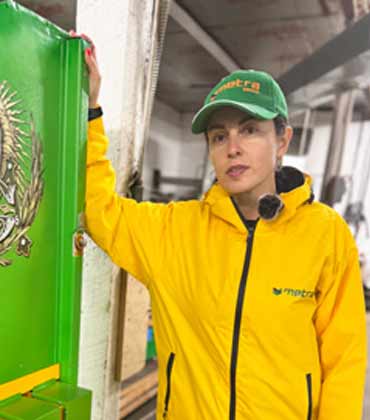
 Anna Smirnov, Vice President
 Grain cleaning has been more about endurance than innovation. Farmers have spent countless hours battling outdated machinery, adjusting screens and trying to outsmart an age-old problem. But what if one adjustment—just a simple shift in airspeed—could change everything? That’s exactly what Metra Grain Cleaners has reimagined with its Aerodynamic Grain Cleaner. It separates grains based on their weight and aerodynamic properties, effortlessly removing dust, chaff, immature kernels and fungal-compromised grains without the need for screens or manual recalibration.
“No More Downtime, Just Results”
Harvest season is a race against time. The last thing farmers need is to pause operations to swap out screens, clear out clogs or fine-tune settings for every different grain type. With Aerodynamic Grain Cleaner, those interruptions become a thing of the past.
This single, compact system seamlessly handles a diverse range of crops—from delicate sesame seeds to robust chickpeas—without requiring manual adjustments. Its on-site mobility eliminates the need for extra transportation, allowing farmers to process grain right where it’s harvested. And because scalability matters, Metra offers models that process anywhere from 80 to 8,000 bushels per hour, making sure both small farms and large-scale operations benefit from its efficiency.
“Our goal is to find the perfect balance between practical needs and financial sense. This isn’t just a machine. It is an investment designed to improve your yield and maximize your returns,” says Anna Smirnov, vice president.
Consider the story of Tony, a North Carolina-based corn grower and organic feed supplier for a major chicken processing company, who discovered his corn had Aflatoxin level soaring to 64 parts per million (ppm). With the standard tolerance range between 10 ppm, his contract with the meat processing company was at serious risk. Leveraging Metra’s advanced grain cleaning technology, he could reduce the antibody levels to 3-4 ppm in a single run. What seemed like a lost crop became profitable just by switching the grain cleaner.
Beyond Clean Grain: AI-Powered Precision
Efficiency alone isn’t enough; quality is just as important. A higher yield means little if imperfections reduce market value. That’s where Metra’s AI-powered color sorter steps in. Integrated into the system, this advanced technology analyzes each grain based on color and texture, ensuring that only the best make the cut. With grains free from discoloration or impurities, farmers can command higher prices and premium market positioning.
Our goal is to find the perfect balance between practical needs and financial sense. This isn’t just a machine. It is an investment designed to improve your yield and maximize your returns
And it doesn’t stop there. Harvesting brings another challenge—inconsistent seed maturity. Some grains ripen fully, while others remain underdeveloped, impacting overall nutritional value and germination rates. Metra’s intelligent sorting ensures uniform seed selection, improving germination rates and leading to up to 40 percent higher yields. With a more reliable crop cycle, farmers aren’t just cleaning grain but cultivating long-term success.
Fighting Fungal Toxins: A Game-Changer for Food Safety
In 2016, Metra made a breakthrough discovery when its technology solved a major food safety crisis. Across farming regions like North Dakota and Montana, fungal toxins were devastating crops, slipping through traditional screen-based cleaning systems and threatening both yield and food quality.
Rather than relying on outdated methods, Metra took a bold approach of leveraging relative density to remove compromised grains. Because fungal-infected grains are often lighter than healthy ones, Aerodynamic Grain Cleaner uses precision airflow to separate the bad from the good—without damaging the harvest. As a result, farmers were not only able to safeguard their crops but maintain the integrity of their yield, assuring contaminated grains never reached consumers.
Invest in the Future of Agriculture
With advanced Italian electric motors, the Aerodynamic Grain Cleaner runs on surprisingly low energy—about the same as a household appliance. That means lower operating costs for farmers and a system that aligns with agriculture’s growing push for sustainability.
Metra is also actively investing in the next generation of agricultural leaders by donating its grain-cleaning system to the University of Nebraska Research Center. In this research-driven environment, students and scientists are getting hands-on experience with cutting-edge grain-processing technology, studying how precision air sorting can improve grain purity, reduce waste and enhance overall efficiency.
These endeavors prove Metra is an embodiment of innovation with purpose—a technology that doesn’t just refine existing processes but redefines the future possibilities of farming.
Advancing Grain Cleaning Economics in Modern Crop Handling
Escalating storage costs, tighter grading tolerances and growing pressure to preserve crop value have altered how grain processors and seed producers evaluate cleaning equipment. Systems once treated as secondary infrastructure now influence pricing outcomes, storage efficiency and seed performance across the entire post-harvest cycle. Buyers responsible for capital allocation are increasingly scrutinizing whether conventional cleaning methods still justify their labor demands, energy consumption and throughput limitations. That tension is especially visible among independent producers and specialty crop operators managing multiple commodities across varying harvest conditions.
Many legacy cleaning systems continue to depend on interchangeable screens, extensive calibration and fixed installation environments that limit flexibility once crop conditions shift. Grain handlers processing wheat one week and legumes or oilseeds the next often face time loss tied to adjustments, maintenance interruptions and inconsistent separation accuracy. The problem intensifies when contaminants share the same physical size as marketable grain. Insect-damaged kernels, fungal contamination and lightweight diseased grain frequently bypass traditional screen-based systems because visual dimensions remain unchanged despite internal degradation. Processors absorbing grading penalties or rejected loads are increasingly prioritizing technologies capable of identifying density variation rather than relying exclusively on size differentiation.
Energy consumption and mobility have also become purchasing considerations in regions where grain cleaning is moving closer to the field rather than remaining centralized inside permanent facilities. Producers storing grain for later market timing want equipment that reduces dockage before storage without adding another labor-intensive stage to harvest logistics. Unclean grain occupying bin space creates downstream complications tied to airflow restriction, moisture retention and spoilage risk. Storage systems become less effective when foreign material interrupts ventilation patterns inside the bin. That inefficiency compounds over time through higher electricity costs, reduced grain quality and delayed market readiness when pricing conditions improve.
Seed producers face a different but equally costly challenge centered on uniformity. Uneven seed density and inconsistent maturation rates reduce field consistency, weaken survivability during difficult growing conditions and complicate harvest timing. Buyers evaluating grain cleaning systems for seed applications increasingly favor technologies capable of separating product by relative density because uniform seed lots contribute to more synchronized germination and improved harvest quality. The commercial implications extend beyond agronomic performance. Producers attempting to reduce dependence on high-cost purchased seed are placing greater value on equipment that allows them to clean and preserve viable planting material internally.
Against that backdrop, purchasing decisions increasingly favor systems that simplify operation without sacrificing throughput. Equipment requiring specialized technicians or continuous screen replacement introduces labor dependence many operations no longer want to absorb. Buyers are gravitating toward platforms that can adapt across multiple commodities through simpler adjustment methods while maintaining cleaning precision at commercial volumes. Reliability has become closely tied to ease of ownership rather than mechanical complexity.
Metra Group has emerged as a strong fit for organizations balancing grain-quality improvement with long-term cost control. Its dynamic grain cleaning systems separate material through relative density and adjustable airflow rather than commodity-specific screening configurations, allowing processors to handle crops ranging from cereals to legumes and specialty seeds through simplified calibration. The equipment’s low power consumption, mobile deployment capability and minimal maintenance requirements address several pressures currently shaping post-harvest investment decisions. Its ability to remove lightweight diseased grain, insect-damaged kernels and dockage before storage aligns particularly well with operations focused on preserving grade value and improving storage efficiency. For buyers evaluating grain cleaning platforms that support both commercial grain handling and seed preparation without adding excessive labor complexity, Metra Group presents one of the more commercially practical solutions in the market.
...Read more