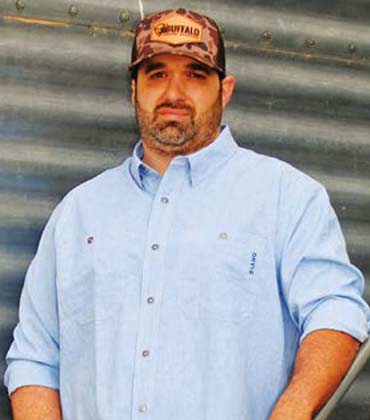
 Bailey Buffalo, Founder
 is setting the benchmark for quality and durability with its high-end grain storage equipment and consultancy services. A farmer's dedication to the harvest process is matched by a trusted partner committed to designing grain systems that maximize efficiency, stand the test of time, and deliver flawless performance for the next 40 years.
“This mindset stems from my industrial and federal construction career, where I prioritized building it right the first time to avoid the need for warranty work or callbacks,” says Bailey Buffalo, founder.
Each of Buffalo Grain Systems’ projects begins with a blank slate, enabling a design that meets the client’s current needs while accommodating future growth and expansion.
The strong emphasis on quality led to a partnership with Chief Agri, the company’s primary supplier of bins, belt and drag conveyors, and bucket elevators. Chief Agri shares the same commitment to excellence, delivering durable, industry-leading performance. From steel strength to corrugation design and galvanized coating thickness, along with the strongest standard roof in the industry, their equipment really frees Buffalo Grain Systems up to provide the longest-lasting solutions for farm and commercial grain storage.
Distinguishing Buffalo Grain Systems is its willingness to go the extra mile. It provides a tailored quote only after conducting a thorough inspection and assessment of the site conditions. The Buffalo team is currently working with a client in Louisiana to select the optimal location for their 500k bushel facility, factoring in truck traffic and the proximity of natural gas lines to accommodate future dryer upgrades.
This mindset stems from my industrial and federal construction career, where I prioritized building it right the first time to avoid the need for warranty work or callbacks.
In a separate project, when a farmer in Tunica, Mississippi, required additional storage for 100,000 bushels, the team encountered a unique challenge: the leased farm lacked sufficient space for additional bins.
With the bins already ordered, the team had to quickly plan the foundation. They first had all the equipment moved off the farm and instructed the farmer to bring his semi-truck with a grain trailer. They identified possible locations for the bins that would still allow truck access, used AutoCAD overlaid on Google Earth, and visualized the layout and pinpointed the only spot where the bins could be placed without disrupting farm operations.
Unlike the farmer’s previous experience, where two other companies provided quotes without visiting the site, the team took the time to conduct an in-person assessment to not overlook any critical detail. A geotechnical survey was performed to evaluate the expansive clay soil, ensuring a stable foundation. They also identified the lack of proper utilities on the farm and arranged for the installation of a new power bank. The holistic approach resulted in a custom storage solution tailored to the farmer’s immediate needs and engineered for long-term stability.
Buffalo Grain Systems goes beyond equipment installation by proactively offering maintenance services, even when not covered by contract. Each year, the team visits farmers before harvest season to inspect equipment and perform preventative maintenance, minimizing the risk of unexpected breakdowns during this busy period.
In addition, Buffalo Grain Systems responds swiftly to maintenance or breakdown calls, with the support of Chief Agri, which ensures reliable response times and confirms part availability and delivery timelines within 12 hours. This quick access to parts proved crucial when a farmer with an older bin experienced simultaneous failure of eight fans. With two fans available in local inventory and a quick call to Chief Agri to source more, the farmer was able to restore cooling and protect the harvested grain.
With a focus on long-term reliability and operational efficiency, Buffalo Grain Systems is the trusted partner for creating robust, sustainable agricultural solutions.
Designing Grain Infrastructure for Long-Term Farm Growth
Harvest delays rarely begin with bin capacity alone. Truck backups at receiving points, overloaded unload systems and poorly planned traffic flow create just as much disruption during peak harvest weeks. Across the agricultural infrastructure and grain handling sector, storage expansion decisions are increasingly tied to how consistently a facility can keep grain moving under harvest pressure. Producers are expected to move grain faster, work within tighter harvest windows and avoid delays that can affect trucking schedules or market timing. Many system failures emerge from overlooked issues in airflow management, unload performance or layouts that cannot absorb heavier harvest volumes without interrupting daily activity.
That pressure has changed how executives evaluate grain handling and storage partners. Price still shapes procurement discussions, yet long-term system performance now carries greater weight once facilities begin operating at harvest pace. Layouts that appear efficient during planning can expose expensive limitations when semis begin queuing and bins reach capacity, particularly when utility access, turning radius constraints or drainage conditions were not fully evaluated before construction. Rural projects often encounter unstable soil conditions, limited electrical service and restricted maneuvering space for trucks, factors that standardized layouts frequently fail to address in practical terms.
Facility planning has consequently moved closer to the center of purchasing decisions. Storage infrastructure now needs to accommodate phased expansion, dryer integration and shifting crop mixes without forcing major reconstruction a few years later. Providers that study harvest traffic patterns, field access and site circulation tend to reduce the likelihood of bottlenecks once harvest begins. A layout designed only around current throughput can become restrictive quickly when acreage expands or hauling schedules change.
Equipment selection has also become more closely scrutinized. Storage performance depends heavily on unload systems, aeration equipment and conveying components that must operate continuously during compressed harvest periods. Premature failures in augers, flooring systems or fan assemblies can disrupt trucking coordination and create grain quality concerns within a matter of days. Procurement teams increasingly examine how suppliers evaluate maintenance accessibility, replacement part availability and manufacturer standards before equipment recommendations move forward.
Service responsiveness carries similar importance because grain handling systems leave little room for downtime once harvest activity intensifies. Brief interruptions can create immediate financial exposure through delayed trucking, additional drying costs or slowed receiving schedules. Many farm operations now operate with leaner labor availability, leaving fewer personnel available to troubleshoot equipment failures internally. Preventive maintenance planning and responsive service coordination have therefore become more influential in supplier selection than they were a decade ago.
Expansion planning has emerged as another dividing line between providers. Agricultural operations rarely remain fixed over the lifecycle of a grain facility. Acreage changes, crop rotation shifts and transportation demands place new pressure on storage layouts over time. Firms that account for future utility demand, truck circulation and additional storage integration during early planning stages help reduce the likelihood of disruptive retrofits later.
Within this environment, Buffalo Grain Systems distinguishes itself through its emphasis on site-specific planning, equipment quality and long-term facility usability. The company approaches installations around field access, truck movement and future expansion requirements rather than relying on standardized layouts. Its work with manufacturers such as Chief Agri and Grain Handler reflects a focus on equipment lifespan, maintenance access and dependable harvest performance. Buffalo Grain Systems also remains involved after installation through preventive maintenance guidance and responsive service coordination, a practical advantage for operations managing narrow harvest timelines and continued facility growth.
...Read more